

The final week of the year is also the last of my humanities crash course. For this week, Gioia recommended assorted texts that touched on how we derive meaning and motivation from our responsibilities to ourselves and others. I also watched a classic film by a beloved and recently departed director.
Readings
Most of these week’s texts were very short — a blessing given my family commitments. Here’s a brief sketch of each:
The White Album, the opening essay of Joan Didion’s collection The White Album (1979). An impressionistic first-person account of the closing years of the 1960s. I sensed intellectual and moral confusion — a portrait of a culture unmoored and drifting.
Bloodchild, a science fiction novella by Octavia Butler that leads her collection Bloodchild and Other Stories (1985). The narrator is a human in an alien world. The story details humans’ symbiotic relationship with a native species that uses them to incubate their offspring.
The Things They Carried, a short story by Tim O’Brien that leads his 1990 collection of the same name. A portrait of a platoon during the Vietnam war: their lives, loves, fears, etc. “They carried all they could bear, and then some, including a silent awe for the terrible power of the things they carried.”
The Awakening of My Interest in Advanced Tax, chapter 22 of David Foster Wallace’s posthumous novel The Pale King (2011). The narrator describes his transition from a collage “wastoid” to joining The Service (aka, the IRS) during the 1970s. His reflections describe his drug use (including television), his parents’ divorce, mother’s descent into mental illness, father’s accidental death, and finding purpose through an accidental encounter.
Chapter five of The Big Book of Alcoholics Anonymous (1939), which describes the AA system. Besides laying out the famous 12-step program, the text emphasizes that alcoholics cannot get better on their own. Instead, they must surrender to higher powers: God and society.
Audiovisual
Music: The work of Stephen Sondheim, an influential American composer and lyricist of show tunes. I was most familiar with Into the Woods, but had also heard selections from West Side Story.
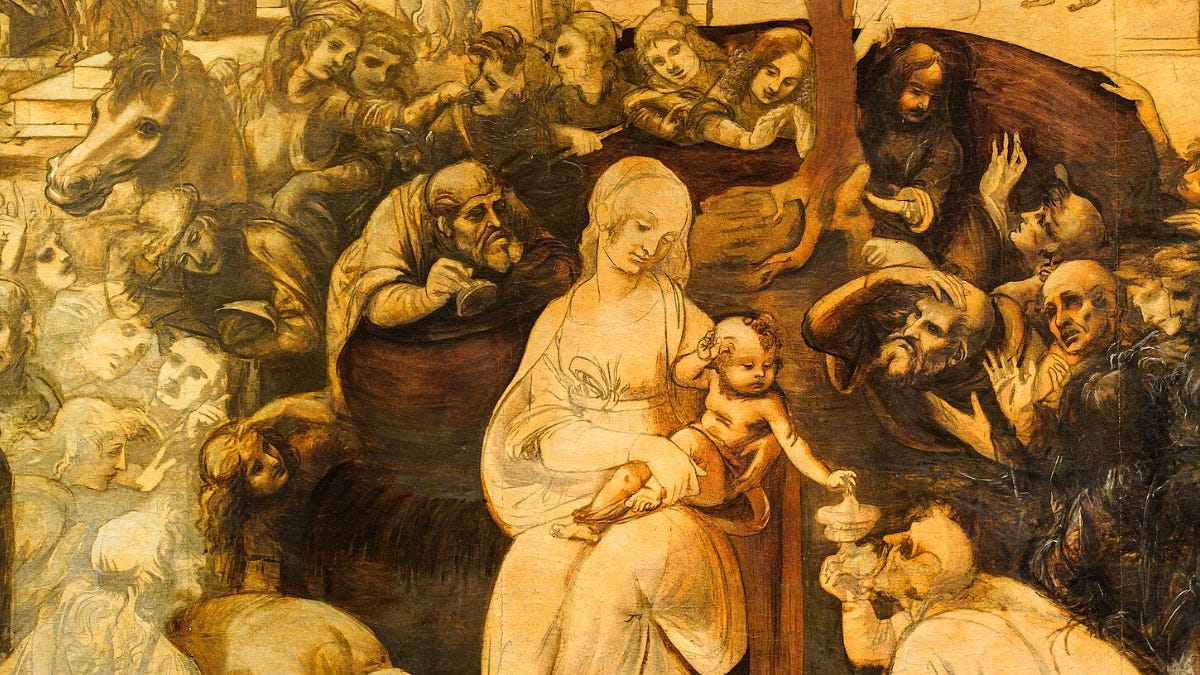
Arts: The paintings of Leonardo da Vinci. I didn’t spend any time this week with Leonardo, since I’ve had the privilege of seeing many of his paintings in person, including a second viewing of the Mona Lisa earlier this year.
](https://substackcdn.com/image/fetch/$s_!mMRC!,f_auto,q_auto:good,fl_progressive:steep/https%3A%2F%2Fsubstack-post-media.s3.amazonaws.com%2Fpublic%2Fimages%2Feade1987-f38b-449b-98df-5c41cf5dadad_1449x2159.jpeg "Leonardo’s painting of the Mona Lisa: a portrait of a woman with a serene expression sitting with folded hands, wearing a dark dress against a blurred landscape background. *Mona Lis*a by Leonardo da Vinci via [Wikimedia](https://commons.wikimedia.org/w/index.php?curid=15442524)")
Cinema: Rob Reiner’s STAND BY ME (1986). I’d seen several other Reiner movies, but not this one. It seemed appropriate given the director (and his wife’s) tragic deaths earlier this month.
The film is a coming-of-age story based on a Stephen King novella. Set in 1959, it tells of four preteen boys who set out on an overnight adventure to view the body of another boy who’s been accidentally killed by a train. Despite the grim topic, the film is a warm chronicle of childhood’s end.
Reflection
This week’s works point to maturity: grappling with becoming a functional adult member of a society. We thrive in stable contexts. That implies some degree of social order. Liberty isn’t freedom from responsibility; it’s freedom through responsibility — especially our responsibilities to each other.
The “flower power” generation missed this. I sensed in Didion’s essay exhaustion and disappointment at where the sixties ended: self-involvement, confusion, lack of direction and meaning, etc. The Manson murders and the Vietnam experience were signs that something had gone wrong.
DFW’s ‘wastoid’ is a natural consequence. Meaning comes through responsibility — and a life devoid of meaning also lacks motivation. His redemption comes through something amiss in his life: an authority figure. The substitute Advanced Tax instructor represents social order. The wastoid isn’t so much drawn to the teacher’s worldview as his M.O. — his demeanor projects confidence and stability. That may be enough.
The four friends’ journey in STAND BY ME is also about maturing. They set off on what they expect will be a cool adventure. Their motivation is fame: their discovery will make them local heroes. Confronting the actual corpse disabuses them of that childish notion.
Treat others as you’d like to be treated. Nobody should be used as a means to an end. There, but for the grace of God, go I. Three sentences that recap many of the lessons from this journey through the humanities.
Notes on Note-taking
I went mostly old school for this last week of the course. The readings were simple enough, so I didn’t resort at all to LLMs. I did read the Wikipedia entries for the readings, but they weren’t strictly necessary.
As with previous weeks, I captured individual notes for the readings and the movie in Obsidian. Writing helps me think about what I’ve read/seen. Knowing that some of these writing will be public changes their tone a bit, but not their substance.
The notes themselves are not an end. I might revisit some of them over time, but most will lie fallow. The goal hasn’t been to facilitate later recall, but processing ideas in the moment. I expect to write more about this distinction over time.
Up Next
I’ve reached the end of Gioia’s syllabus. Of course, this isn’t the end of my self-education: I will continue reading and experiencing other works. But this is also the end of this series of posts. Thanks for reading — I hope this was as valuable to you as it was to me.
This post originally appeared on my blog.